
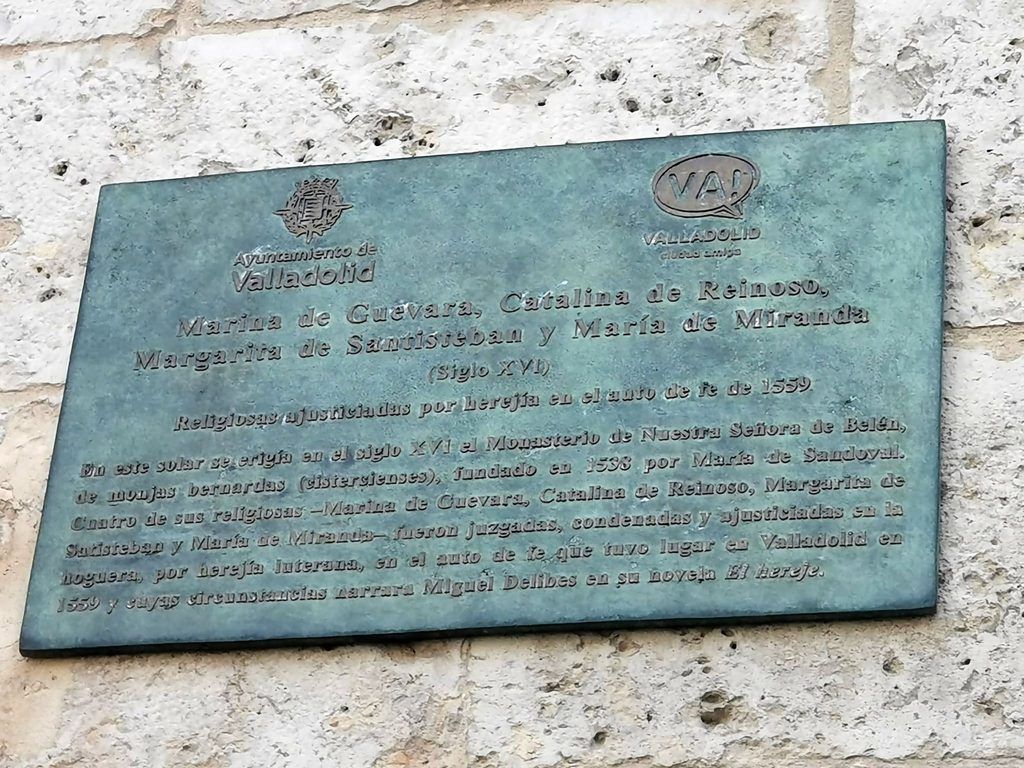
Commemorative plaque located at the former site of the Monastery of Our Lady of Bethlehem (Nuestra Señora de Belén), Valladolid:
“On this site in the sixteenth century stood the Monastery of Our Lady of Bethlehem (Nuestra Señora de Belén), belonging to the Bernardine (Cistercian) order and founded in 1538 by María de Sandoval. Four of its nuns—Marina de Guevara, Catalina de Reinoso, Margarita de Santisteban, and María de Miranda—were tried, convicted, and executed at the stake for Lutheran heresy during the auto-da-fé celebrated in Valladolid in 1559; these events served as the historical framework for Miguel Delibes’ novel El Hereje.”
(Note: Although the plaque indicates 1558, the trial and execution of these four Cistercian nuns took place during the second major Valladolid auto-da-fé on October 8, 1559).
Primary Historiographical Record
In his Crónica de la Provincia de Valladolid (1869), historian Fernando Fulgioso provides the following account regarding the condemned:
“…having refused to recant, Don Carlos de Sesso and Juan Sánchez were burned alive. De Sesso had been apprehended in Pamplona while attempting to flee alongside the Dominican friar Fray Domingo de Rojas, brother to the Marquess of Poza. Leading the procession of the condemned, they were followed by Diego Sánchez, a secular priest from Villamediana; Pedro de Cazalla, parish priest of Pedrosa and brother of the celebrated Dr. Agustín Cazalla; the aforementioned Juan Sánchez; and four nuns from the Convent of Bethlehem—all hailing from noble lineages, as evidenced by their surnames: Doña María de Guevara, Doña Catalina de Reinoso, Doña Margarita Santiestéban, and Doña María de Miranda.
Also among the condemned were Eufrasia de Mendoza, an escaped nun from the Monastery of Santa Clara in Palermo; Pedro Sotelo of Zamora; Francisco de Almarza of Soria; and Gaspar Blanco, a morisco. Accompanying them in the procession was the effigy representing Juana Sánchez, a beata from Valladolid who had committed suicide in prison with a pair of shears…”
Photograph provided courtesy of historian Marcial de Castro.
Leave a Reply